Oregon, We Have a Problem
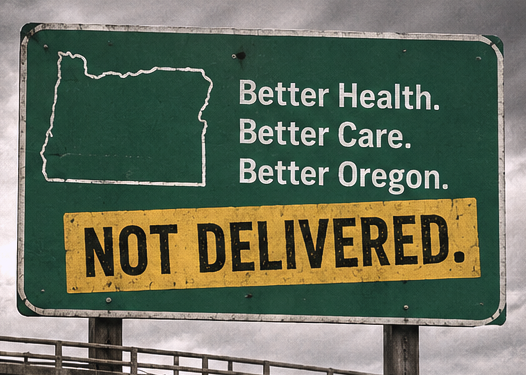
Oregon, We Have a Problem
Folks, I’m worried. I’m so worried about my fellow Oregonians.
Not in the abstract. Not in the vague, hand-wringing way politicians like to perform concern. I mean genuinely worried about what is happening right now inside our healthcare system—specifically the Oregon Health Plan—and what it means for the people who rely on it.
I’m a mental health provider. I work with people every day who are trying—really trying—to keep their lives together. They’re parenting, working, recovering, surviving trauma, managing severe depression, psychosis, addiction, chronic illness, poverty, and grief. Many of them are covered by OHP. For some, it is the only thing standing between them and complete collapse. And what I’ve learned over the last year while trying to build services inside this system has been disturbing.
Oregon sells itself as progressive, humane, and innovative in healthcare. We were early adopters of Medicaid expansion. We talk constantly about access, equity, and integrated care. On paper, it sounds impressive. But on the ground, it’s increasingly hard to ignore how much of it feels like bureaucracy feeding itself.
Here’s what I mean. To provide care under OHP beyond the simplest outpatient therapy model, providers often have to navigate layers of certification, credentialing, contracting, and administrative review that can take months—or longer. Not because the standards are necessarily wrong. Some oversight is appropriate. But because the process itself has become bloated, fragmented, and opaque.
You submit paperwork. You wait. You ask for updates. Silence. You call. No one knows where your application is. You email. Someone tells you it’s “in process.” What process? With whom? On what timeline? No one can tell you. Meanwhile, people in crisis are waiting.
This isn’t just frustrating for providers. It’s dangerous for patients and catastrophic for communities. In Oregon, we have entire counties designated as mental health shortage areas. Waitlists can run months. Some therapists don’t take OHP at all because reimbursement is too low or administrative demands are too high. Community mental health programs are overwhelmed. Residential beds are scarce. Youth services are bottlenecked. Crisis response is inconsistent depending on where you live.
Emergency departments and jails have increasingly become de facto psychiatric holding systems—not because they were designed for that, but because the actual treatment pipeline is too thin. And yet, despite all this, the machinery keeps expanding. More committees. More studies. More reports.
Oregon has produced countless behavioral health assessments, strategic plans, equity reviews, transformation initiatives, and task forces. Many of these reports are not cheap. Consultants are paid. Advisory groups are convened. Staff time is extensive. Meetings multiply. And still, people can’t get seen.
At some point, we have to ask a hard question: Who is this system optimized for? Because it increasingly does not appear optimized for patients. Or frontline workers. Or small community-based providers trying to fill gaps. It often looks optimized for institutional continuity—keeping administrative ecosystems intact, preserving managed care structures, and producing the appearance of movement rather than actual movement. That distinction matters. Because when systems become self-protective, they stop responding to need.
I’ve sat in meetings with government staff where it became clear very quickly that the purpose was not problem-solving but containment. To explain why things are the way they are. To reassure. To redirect. To absorb frustration without changing the underlying structure. That’s not governance. That’s pressure management. And Oregonians should care.
If you’re on OHP, this affects you directly. If you pay taxes, this affects you directly. If you have a family member waiting for therapy, detox, housing support, medication management, or a psychiatric evaluation, this affects you directly.
This is not about attacking Medicaid. Quite the opposite. OHP matters. Medicaid matters. Mental health services save lives. But systems that matter most require the highest scrutiny—not blind loyalty.
“Progressive” politicians become performative when they assume good intentions are enough. They aren’t. “Good intentions” can coexist with inefficiency. “Good intentions” can coexist with waste. “Good intentions” can coexist with institutional arrogance. And when that happens, vulnerable people pay the price.
So what do we do?
Stop being intimidated by complexity. A lot of this survives because it feels too complicated to challenge. It isn’t. Ask basic questions:
Why does certification take this long?
Where is the bottleneck?
Who is accountable?
How much money is being spent on administration versus direct services?
What measurable improvements followed the last $10 million report?
These are not radical questions. They’re responsible ones. Public systems require public accountability. If agencies can absorb money, time, and public trust without demonstrating measurable outcomes, something is wrong. Oregonians should not be asked to keep funding expansion without a clear accounting of what the current funding is accomplishing. At some point, when government workers no longer meets the needs of the people, their jobs look like welfare for the middle class.
Use public records.
Oregon has public records laws. Use them. Request timelines, contracts, consultant payments, internal process maps, and performance metrics. Systems behave differently when they know someone is looking.
Talk about it publicly.
Sustained public pressure matters. Systems change fastest when silence becomes impossible. Not just when there’s a tragedy. Not just when someone dies by suicide, decompensates in public, lands in jail, or hurts someone else. By then, the system is already responding at its most expensive and least effective point.
That’s the pattern we’ve normalized: Wait for catastrophe, then act shocked. We investigate after the overdose. We review after the child falls through the cracks. We convene task forces after the psychotic break, the homelessness, the violence, the preventable death. But reaction is not prevention.
A tragedy is not evidence that the system finally noticed. It’s evidence that the system missed multiple chances to intervene earlier. And those earlier interventions are almost always cheaper, more humane, and far less destructive than what comes after. If we only pay attention once someone is broken enough to become visible, we are not building a healthcare system. We are building a triage machine.
Here’s the truth: A system doesn’t have to be malicious to cause harm. It just has to be slow, insulated, and unaccountable long enough. And right now, I’m seeing too many signs that Oregon’s behavioral health system is drifting in exactly that direction.
That should worry all of us.