Filling in the Gaps
Filling in the Gaps
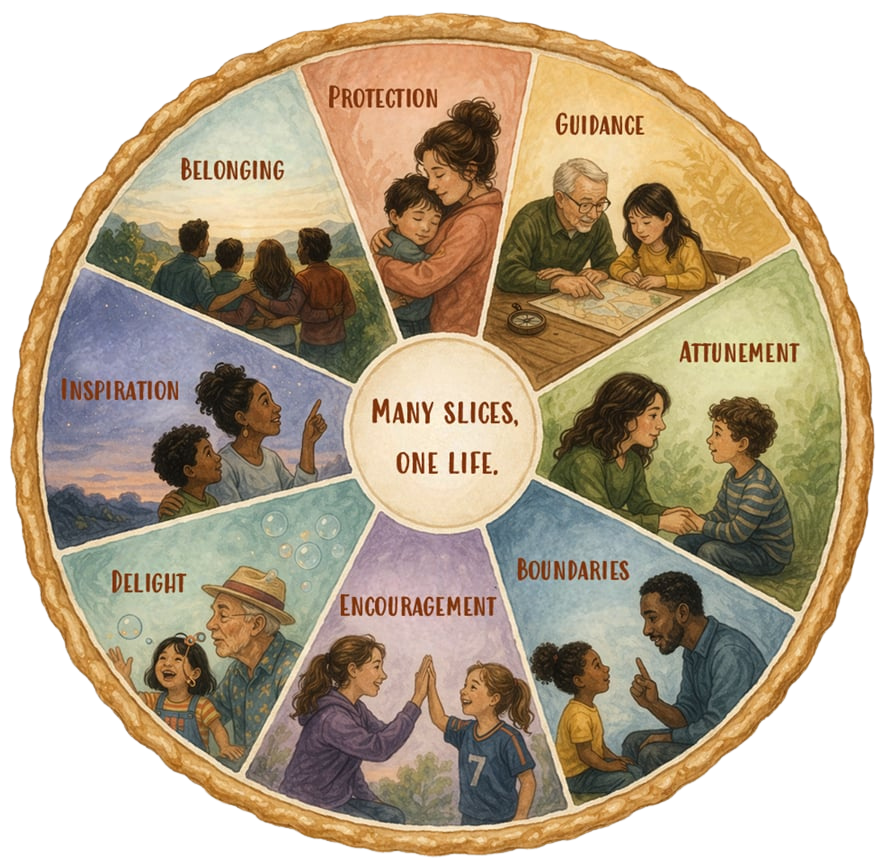
In therapy, I often invite people to think about what I call the “mother pie” and the “father pie.” These aren’t judgments about parents—they’re a way of understanding the ecology of our early emotional development. No single caregiver, even the most loving and stable, can meet every need a child has. We require a wide range of emotional nutrients: protection, delight, guidance, attunement, boundaries, encouragement. And different people in a child’s world naturally provide different pieces of that nourishment.
Across childhood, we intuitively assemble a pie made up of many slices. A coach’s belief might strengthen our sense of competence. A neighbor’s gentle humor might give us a model for warmth. A teacher’s steadiness might become a quiet anchor. Most of this happens beneath awareness; children are exquisitely sensitive to where care resides, and they instinctively orient toward the people who can meet the need of the moment. When a caregiver is limited in one area, children don’t stop needing—they diversify. That’s not pathology. That is resilience.
In families marked by flexibility and emotional safety, this diversification is welcomed. Parents understand—sometimes explicitly, often intuitively—that they are part of a larger network of influence. They can feel relief knowing their child is held by multiple relationships. But in more rigid, enmeshed, or chronically stressed family systems, a child’s turn toward others may be misinterpreted as disloyalty. Support outside the family can be framed as a threat, and the child learns to collapse their needs, hide them, or feel guilt for having them at all. Over time, this creates an internal conflict: a push–pull between seeking connection and maintaining loyalty.
Many adults carry that conflict long after childhood ends. They may minimize the gaps that existed, or feel uncomfortable acknowledging the people who stepped in to meet certain needs. There can be a persistent internal rule: naming what was missing is disloyal; receiving from others is somehow a betrayal. These beliefs often operate quietly but shape how we allow ourselves to connect as adults.
But the truth is that the “parent pie” doesn’t freeze in childhood. The needs themselves mature, but they do not evaporate. As adults, we can intentionally seek relationships—mentors, friends, communities, partners, therapists—who help fill in the slices that were thin or absent. The work is not about replacing our parents; it’s about completing the picture. It’s about letting support from others be real and letting it matter.
Reframing the pie in this way often softens extremes. It makes space for a more balanced narrative, one that can hold both gratitude and disappointment simultaneously. We can acknowledge the meaningful pieces our parents provided without pretending they offered every slice. And we can honor the people who stepped in without seeing that as a betrayal of where we came from.
In that more nuanced story, many people find room for compassion—toward their parents, toward the others who shaped them, and often most importantly, toward themselves.